Saying Thank You
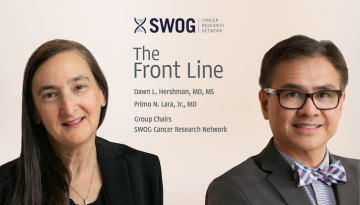
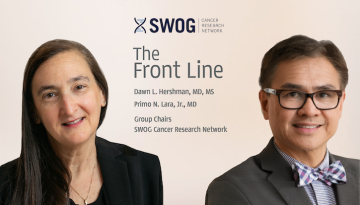
This piece marks my last Front Line post as SWOG group chair. I’m pleased that Drs. Lara and Hershman, who will officially become chairs of the group on Sunday, plan to continue this leadership blog as a forum for communicating with SWOG members. So, please continue to tune in!
I have been honored to serve as chair of this research group over the last 13 years, and I could not be prouder of what you have accomplished in that time.
In addition to specific trial results that have changed practice and improved lives, we’ve also accomplished some astonishing changes for the better in the who, what, where, why, and how of our research endeavor.
Looking back on my time as chair, here is a list – in no particular order – of some of the accomplishments I’m most proud of.
- We brought clinical research opportunities back to our military veterans, by re-engaging Veterans Affairs medical centers in National Cancer Institute trials. The success of SWOG’s initial steps toward this goal eventually inspired NCI–VA level joint efforts, and collectively we’ve grown VA enrollments in NCI cooperative group studies from just a handful in 2012 to several hundred annually in recent years. And progress continues.
- We led the way in the NCTN, in robustly integrating the perspectives of patient advocates into all stages of clinical trial conception, planning, design, conduct, and dissemination, establishing a model other NCTN groups have followed and adding immensely to the quality and value of our research.
- We invested in SWOG as a global organization, particularly in conducting hemisphere-wide clinical trials through our SWOG Latin America Initiative collaboration with national cancer institutes in multiple countries. I am especially proud that at this point some of our member sites in Central and South America regularly appear on our lists of top-accruing institutions.
- We championed research on palliative and end-of-life care questions, and formalized this work as an essential component in a cancer research committee.
- We launched the SWOG Clinical Trials Partnerships as a mechanism for more intensively collaborating with industry partners to expand our ability to conduct important clinical trials beyond those the NCI can support.
- We made SWOG the NCTN leader in precision oncology with group leadership of the NCI’s first precision medicine trial in lung cancer – Lung-MAP – and of the core screening protocols for two of three of the NCI’s second generation of precision medicine initiatives: myeloMATCH and ImmunoMATCH.
- We designed and road-tested a model for efficiently studying new treatments for rare and ultra-rare cancers with our S1609 DART basket trial, which rolled 53 rare cancer studies into one. Positive findings from one or more of DART’s 53 cohorts are now published or presented roughly monthly.
- We strengthened our commitment to translational medicine research and expanded our TM research output – creating two high-level leadership roles to oversee this work, convening a TM retreat in 2014 to set strategic direction, implementing a dedicated TM plenary session at group meetings to raise awareness, initiating a TM Link of the Week email to keep our investigators informed, and – via The Hope Foundation – funding more than 60 TM projects to the tune of more than $6 million over those 13 years.
- We worked with the FDA and the NCI to establish a new paradigm for streamlined, pragmatic trials that can rapidly enroll a highly representative group of patients and efficiently return results, even in an FDA registrational setting. Pragmatica-Lung set the standard and should continue to do so for years or decades to come.
These achievements are products of the collaboration of a cast of thousands, a cast that includes every SWOG member reading this. I’ve been honored to lead this collaboration and to be able to look back on these accomplishments and how they further our ultimate goal – improving the lives of those with cancer.
After 13 years, the closing message I most want to send to you is to simply say thank you!
Here’s a final footnote (and, perfectly, a scientific breakthrough) about a particularly exciting result we published yesterday in JAMA Oncology: based on their cure model analysis of 15-year follow-up data from our S0016 trial in follicular lymphoma, the authors state that follicular lymphoma can now be considered a curable disease for many patients, when treated with standard chemoimmunotherapy combinations.
When cancer researchers as cautious, reasonable, and knowledgeable as Drs. Jonathan Friedberg and Michael LeBlanc (among others) boldly apply the word “cure” to a disease previously considered incurable, it’s a pretty lovely finale to my terms as chair.
Here’s the JAMA Oncology paper (lead author is Dr. Mazyar Shadman) and here’s our press release on the results.
Other Recent Stories