S1827 Trial in SCLC: One Less Intervention
SWOG specializes in pursuing clinical answers that may improve patients’ lives but don’t offer a financial return that might make them attractive to for-profit sponsors. We’ve just heard initial results from another such trial – S1827 in small cell lung cancer (SCLC).
Patients with this aggressive form of lung cancer are at high risk of brain metastases. Prophylactic cranial irradiation (PCI) reduces the incidence of brain mets and was found to improve overall survival for these patients. It became part of standard treatment.
But brain irradiation can take a neurocognitive toll. With MRIs becoming more routine, questions emerged about whether close monitoring with regular MRI scans – allowing for early treatment of metastases – could eliminate the need for PCI, and its risk of neurotoxicity.
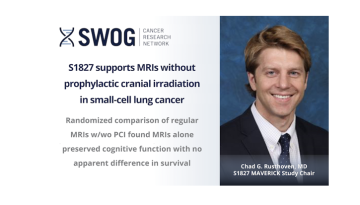
The SWOG S1827 MAVERICK trial was designed to answer this question. It randomized 304 patients with SCLC to regular MRI surveillance, either with or without PCI.
Study chair Dr. Chad Rusthoven presented S1827’s primary results last weekend to a Presidential Symposium at the IASLC 2026 World Conference on Lung Cancer in Seoul. (Read our press release.)
He reported that patients on the MRI-only arm had significantly better cognitive failure-free survival – the trial’s primary endpoint – than patients who also received PCI.
This cognitive failure-free survival benefit (time alive and without cognitive failure, as measured with a battery of six standardized tests) was consistent whether patients had limited-stage SCLC or extensive-stage disease, and the benefit didn’t differ significantly between patients who had immunotherapy and those who didn’t.
And although there’s not yet sufficient data for a final analysis of overall survival, preliminary OS analysis found no apparent difference between the arms.
This is the latest of several recent SWOG advances against SCLC.
Our S1929 trial enrolled patients whose extensive-stage SCLC was positive for a specific molecular biomarker and randomized them to immunotherapy with or without a biomarker-targeted agent.
Those on the targeted treatment arm had significantly longer progression-free survival than their control arm counterparts.
In addition to identifying an effective treatment for a group of patients, S1929 demonstrated that selecting treatment based on predictive biomarkers is feasible in this disease.
That opened the door for future trials to evaluate new SCLC therapies in biomarker-selected populations.
Our S2409 PRISM trial is one of the first trials to do so. It applies the precision medicine paradigm long used in NSCLC to the treatment of SCLC.
The trial enrolls patients with extensive-stage SCLC and tests each patient’s tumor tissue to classify it among several molecular subtypes.
Patients are assigned to a treatment cohort based on that subtype and are then randomized to immunotherapy or immunotherapy plus a targeted therapy.
Activated in September 2025, S2409 is the first trial to prospectively test patients for these SCLC subtypes and to use the results to guide treatment.
What’s next for SWOG in SCLC? Well, preliminary quality-of-life results from S1827 are slated for presentation at the American Society for Radiation Oncology (ASTRO) Annual Meeting later this month. Tune in September 27th.
Other Recent Stories